Topic 3.12: Properties of Photons Worksheet

Topic 3.12: Properties of Photons Worksheet
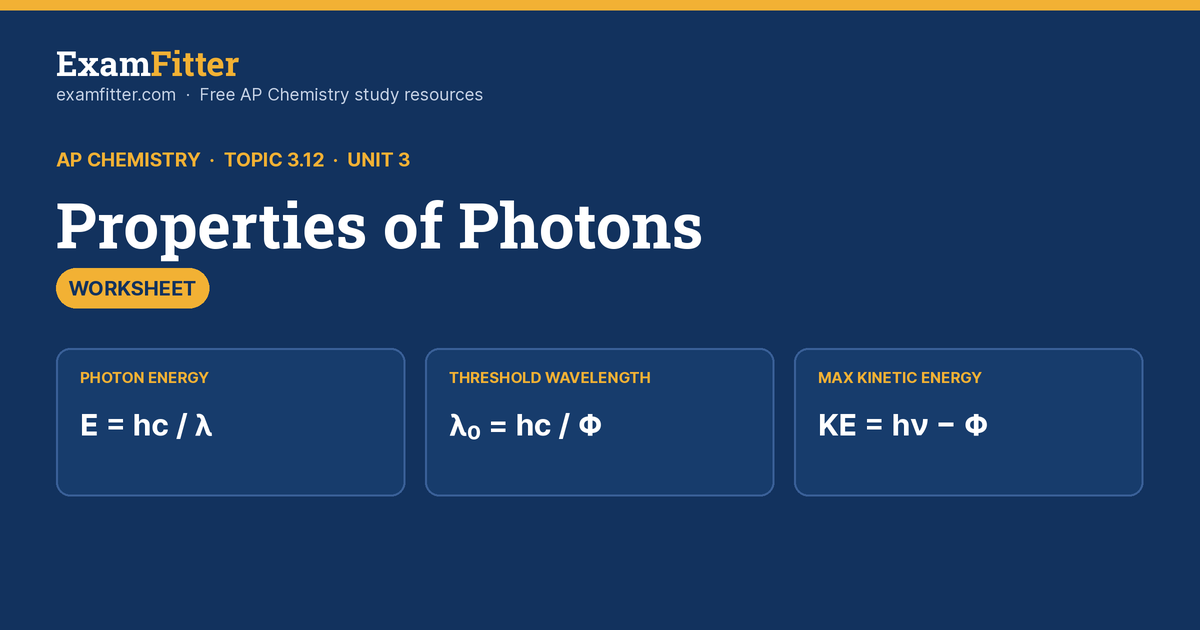
How to Use This Worksheet Work in order. Section A checks the ideas: what a photon pays to free an electron, what the work function and threshold frequency mean, and what intensity does and does not control. Section B builds the calculations: maximum kinetic energy in joules and in electron volts, threshold frequencies and wavelengths, … Read more
Topic 3.12: Properties of Photons Revision Notes

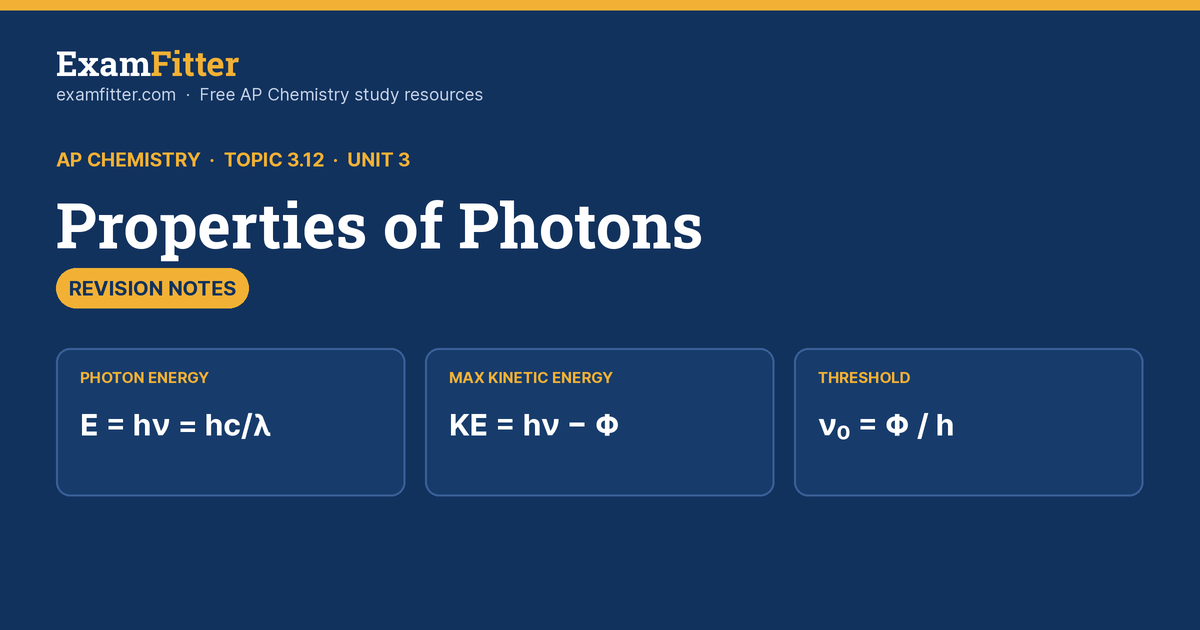
Topic 3.12: Properties of Photons Revision Notes

One Photon, One Electron Shine light on a clean metal surface in a vacuum and, under the right conditions, electrons are knocked straight out of the surface. This is the photoelectric effect, and it is the experiment that forced physics to treat light as particles. The photon picture from Topic 3.11 does the explaining. Light … Read more

Topic 3.11: Spectroscopy and the Electromagnetic Spectrum Worksheet

Topic 3.11: Spectroscopy and the Electromagnetic Spectrum Worksheet

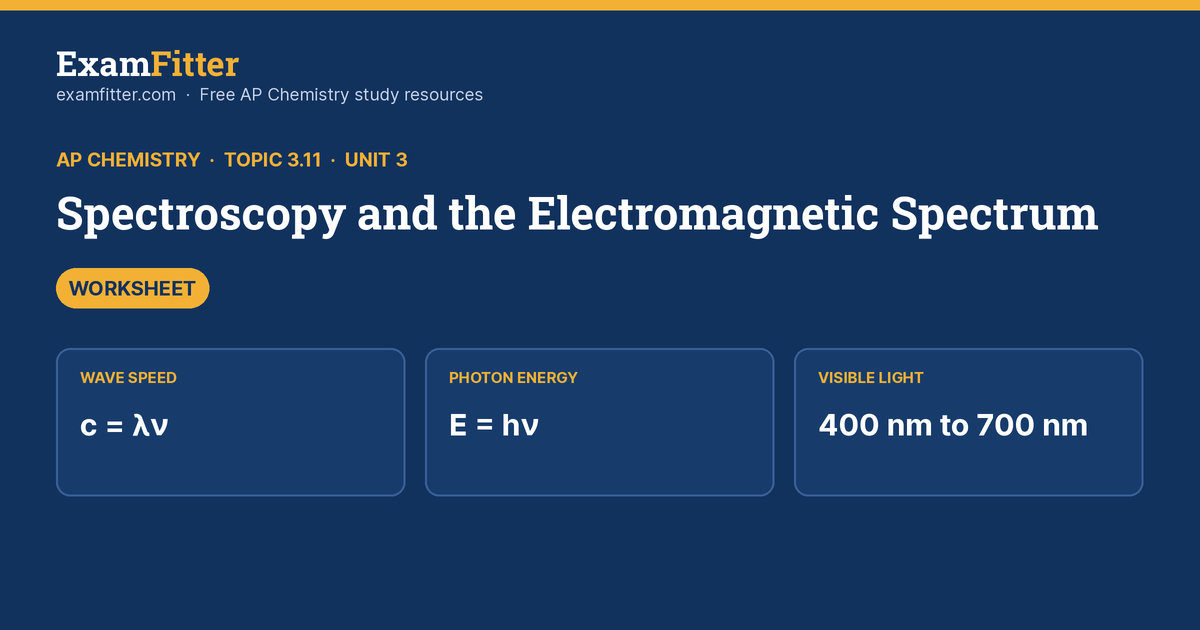
How to Use This Worksheet Work in order. Section A checks the ideas: the order of the spectrum, how wavelength, frequency and photon energy move together, and what spectroscopy is. Section B builds the calculations: frequency from wavelength, photon energy, energy ratios and energy per mole of photons. Section C combines identification, absorption and per … Read more

Topic 3.11: Spectroscopy and the Electromagnetic Spectrum Revision Notes

Topic 3.11: Spectroscopy and the Electromagnetic Spectrum Revision Notes

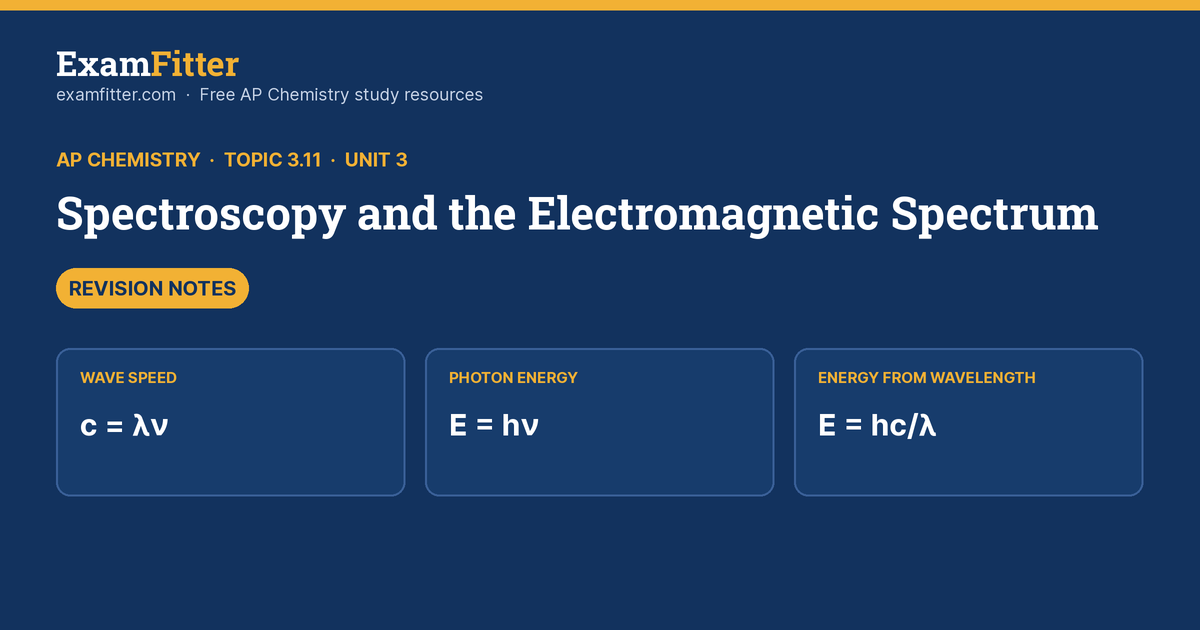
Spectroscopy: How Radiation Meets Matter Spectroscopy is the study of how electromagnetic radiation interacts with matter: how substances absorb, emit and transmit radiation across the whole spectrum. Matter does not interact with every wavelength in the same way. Each substance absorbs and emits a characteristic set of wavelengths, set by its structure, so the pattern … Read more

Topic 3.10: Solubility Worksheet

Topic 3.10: Solubility Worksheet

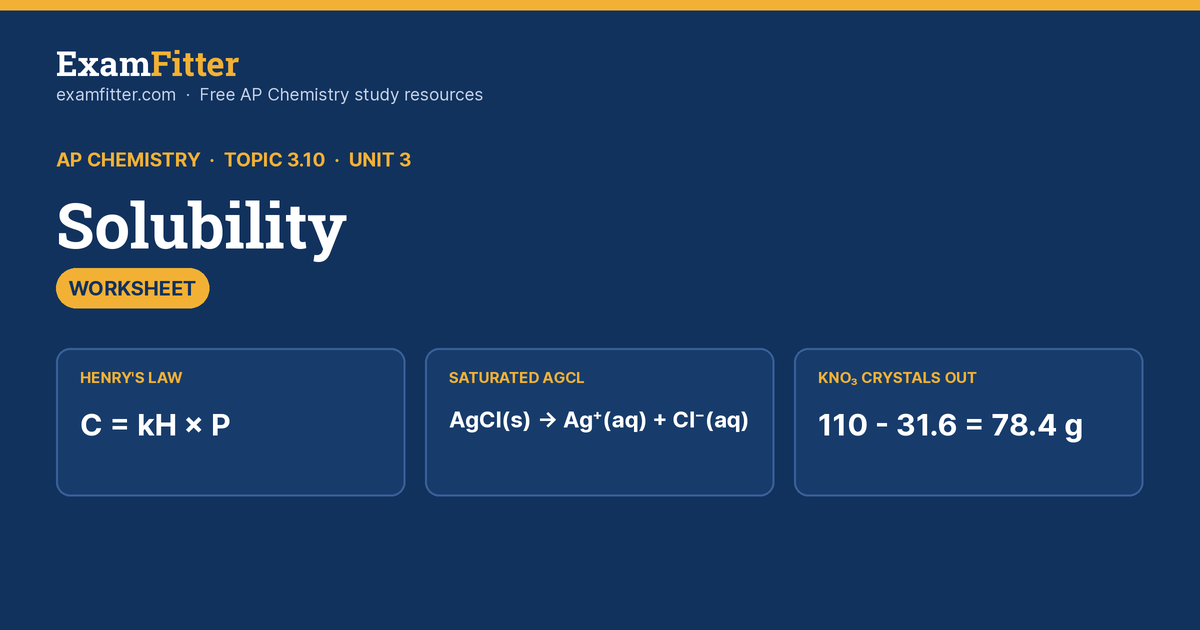
How to Use This Worksheet Work in order. Section A checks the ideas: the three energy steps of dissolving, like dissolves like, saturation, and the effects of temperature and pressure. Section B builds the calculations: energy cycles, the solubility curve and Henry’s law. Section C combines energetics, entropy and precipitation in exam style. Every value … Read more

Topic 3.10: Solubility Revision Notes

Topic 3.10: Solubility Revision Notes

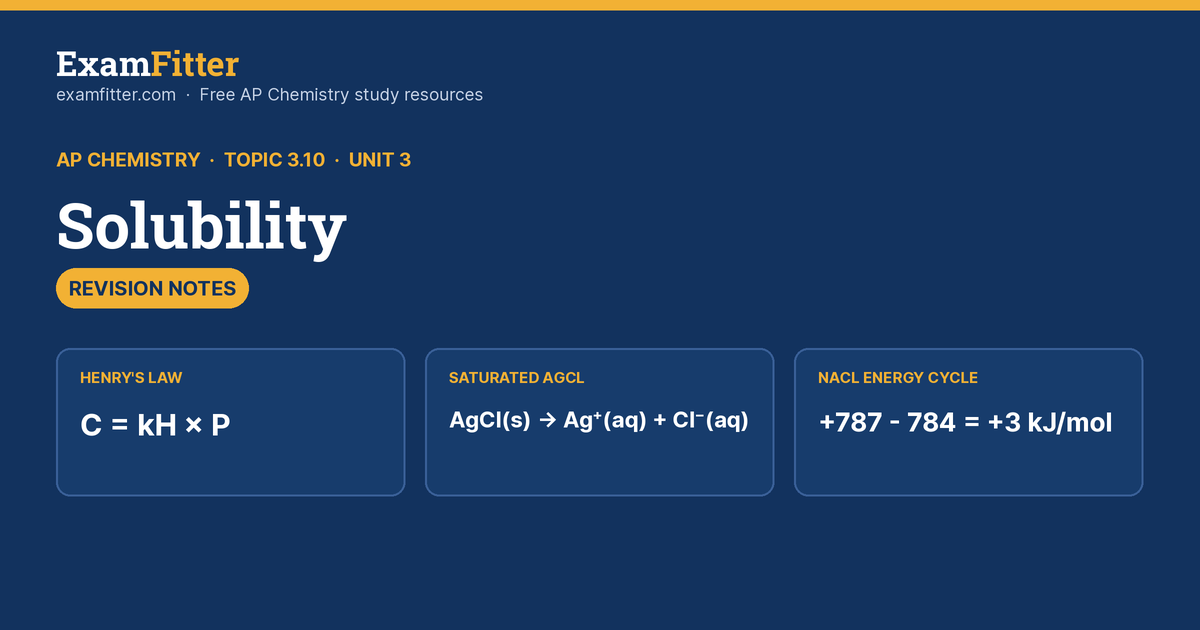
Dissolving Is a Contest Between Three Sets of Attractions A solution forms when solute particles separate and disperse among solvent particles, and whether it forms depends on three sets of attractions. Separating solute particles costs energy, and so does separating solvent particles to make room. Forming new solute-solvent attractions releases energy. Dissolving is favoured when … Read more

Topic 3.9: Separation of Solutions and Mixtures Worksheet

Topic 3.9: Separation of Solutions and Mixtures Worksheet

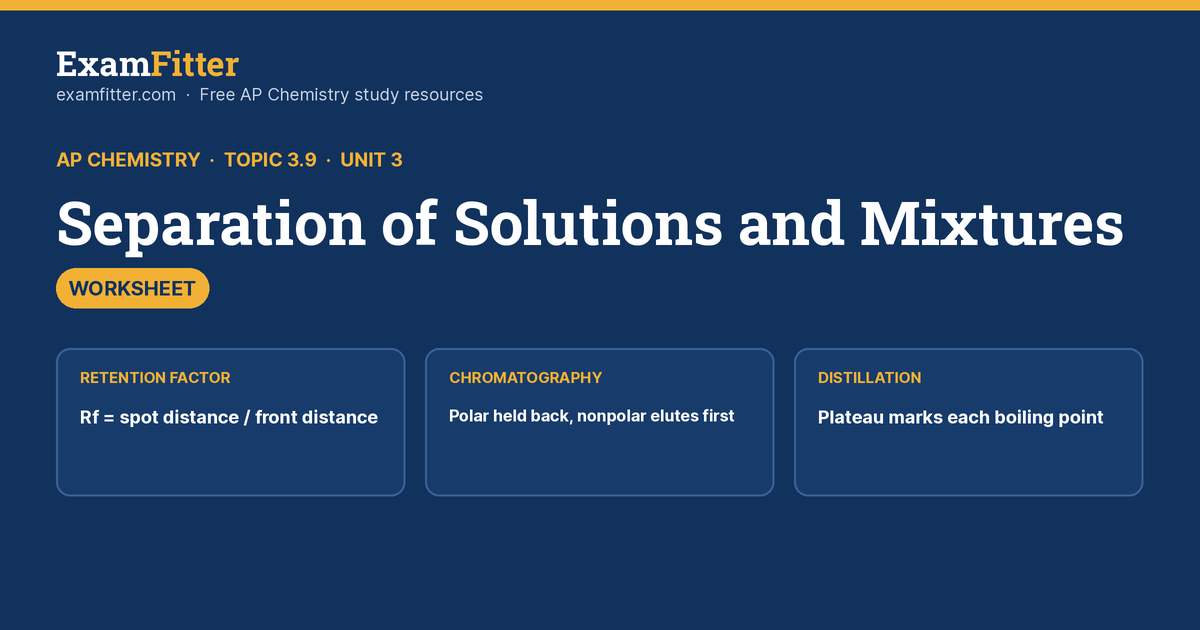
How to Use This Worksheet Work in order. Section A checks the ideas: the two phases, polarity and boiling point. Section B builds Rf calculations, identification and choosing a technique. Section C combines chromatograms, columns and distillation in exam style. Every chromatogram is described completely in words, with front and spot distances stated, so each … Read more

Topic 3.9: Separation of Solutions and Mixtures Revision Notes

Topic 3.9: Separation of Solutions and Mixtures Revision Notes

Separation Uses a Difference in Properties A mixture can be separated because its components keep their own properties. No reaction is needed, and each component is recovered unchanged. Every method here exploits one named difference. Chromatography uses differences in attraction to two phases. Distillation uses differences in boiling point. Chromatography Is a Competition Between Two … Read more

Topic 3.8: Representations of Solutions Worksheet

Topic 3.8: Representations of Solutions Worksheet

How to Use This Worksheet Work in order. Section A checks how you read a particulate diagram: key, counts, hydration shells and spacing. Section B turns counts into molarities and back. Section C combines diagrams and calculations in exam style. Every diagram is described completely in words, so each question can be answered from the … Read more

Topic 4.6: Introduction to Titration Quiz

Master AP Chemistry Topic 4.6 with this free practice quiz. Test your skills on titrants and analytes, equivalence point, end point, indicators, and burette readings to prepare for your AP exam. What a Titration Measures A titration finds the concentration of a solution by reacting it with a solution of known concentration until the reaction … Read more