Topic 2.1: Types of Chemical Bonds Revision Notes

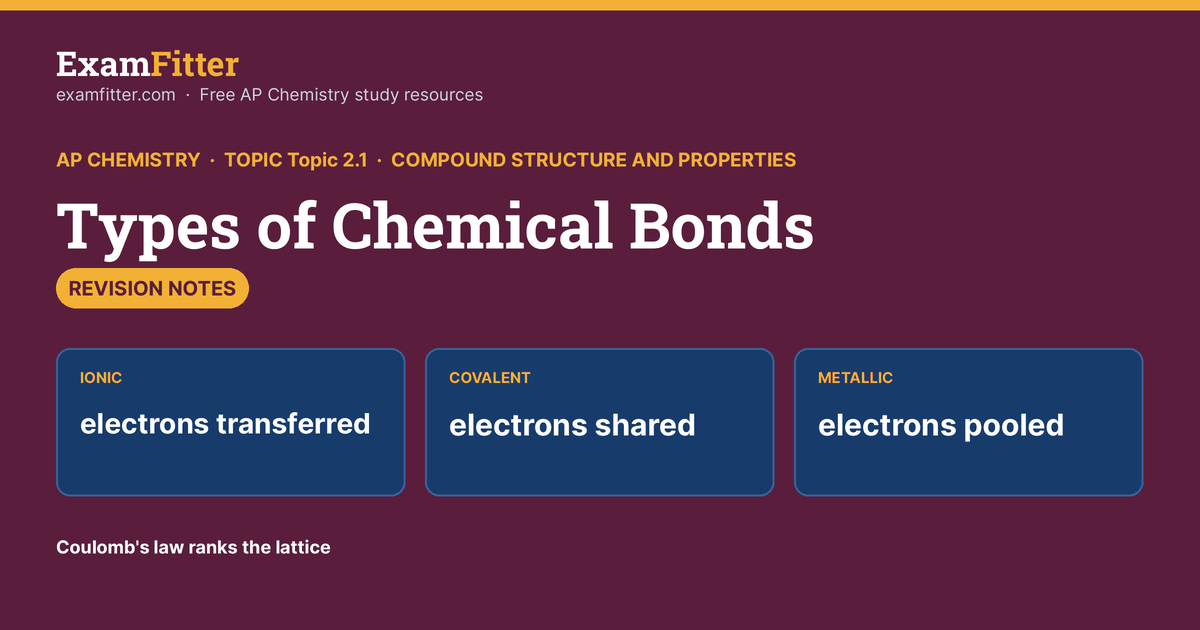
Topic 2.1: Types of Chemical Bonds Revision Notes

Why Bonds Form At All Atoms bond because the bonded arrangement has lower potential energy than the separated atoms. Electrons and nuclei arrange themselves into the configuration where attractions are maximized and repulsions are minimized, and that arrangement holds together. Every bond type in this topic is the same story told with different electron behaviour. … Read more

Topic 1.7: Periodic Trends Revision Notes

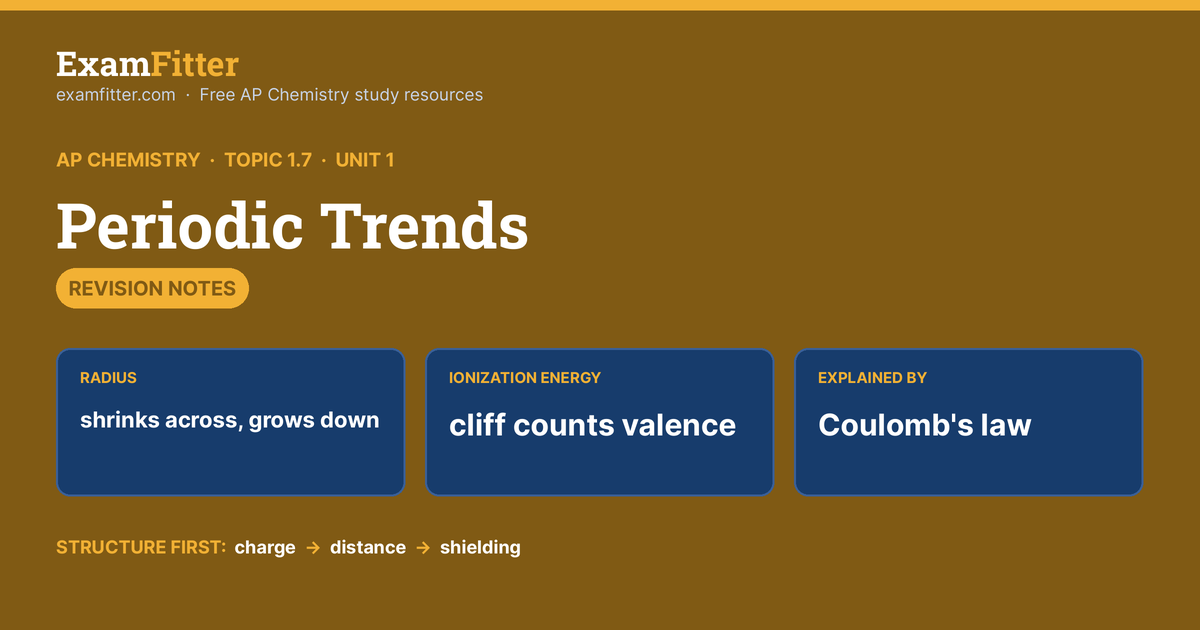
Topic 1.7: Periodic Trends Revision Notes

The One Idea Behind Every Trend Almost every periodic trend is Coulomb’s law wearing different clothes. The attraction between a nucleus and an electron grows with the charges involved and shrinks rapidly as the distance between them grows: F ∝ (q₁ × q₂) ÷ r². For a valence electron, the charge it actually feels is … Read more

Topic 1.6: Photoelectron Spectroscopy Revision Notes

Topic 1.6: Photoelectron Spectroscopy Revision Notes

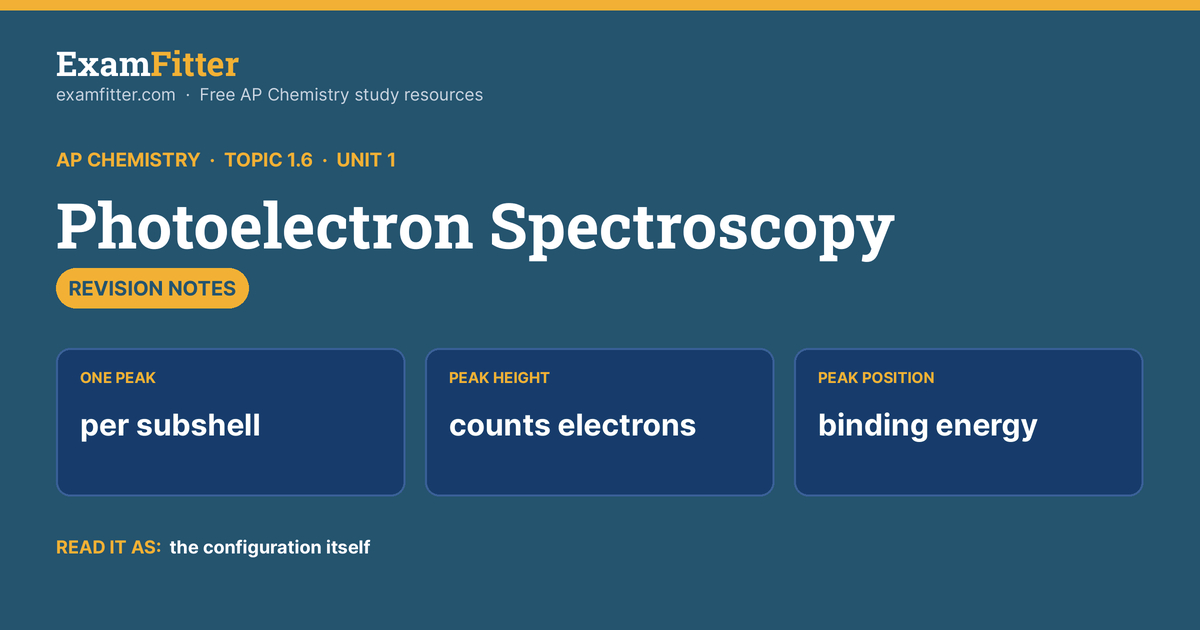
What a Photoelectron Spectrum Is Photoelectron spectroscopy, PES, is an experimental technique that reads an element’s electron configuration directly. A sample is hit with high energy photons, and the photons knock electrons out of the atom. Each photon gives up its energy to free one electron. Whatever energy is left over becomes the kinetic energy … Read more

Topic 1.4: Composition of Mixtures Revision Notes

Topic 1.4: Composition of Mixtures Revision Notes

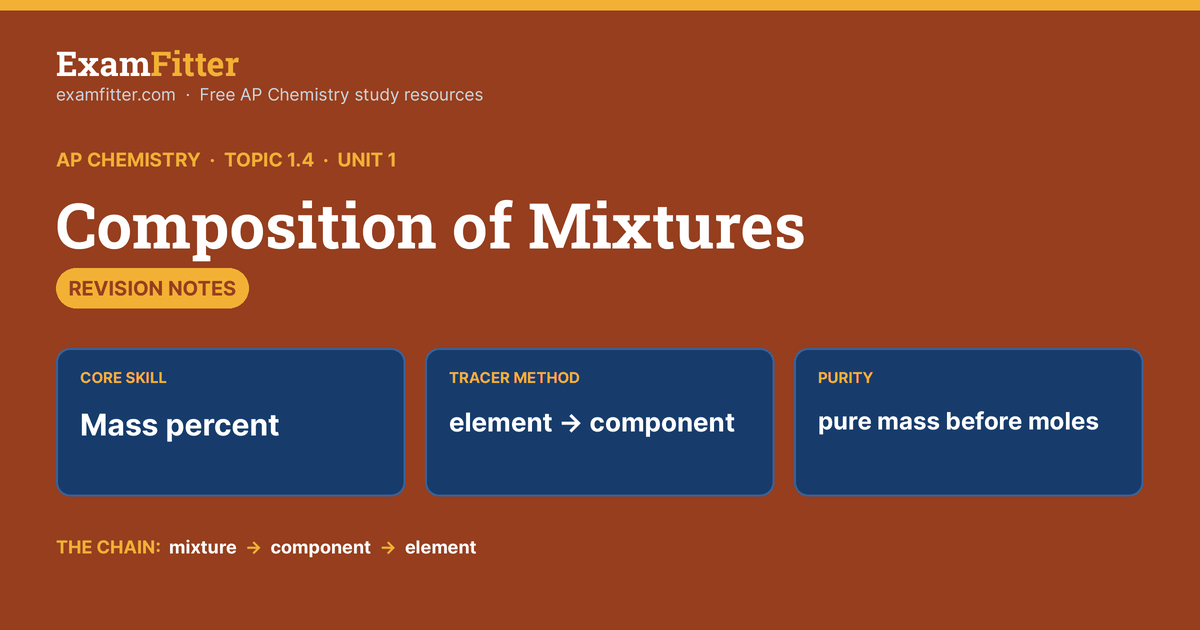
Mixtures Are Not Compounds A pure substance has a fixed composition. Water is always 11.2% hydrogen by mass, and calcium carbonate is always 40.0% calcium, because their formulas fix the ratios. A mixture has no formula. It is two or more substances physically combined, and its composition depends on how much of each part went … Read more

Topic 1.1: Mole Conversion Revision Notes

Topic 1.1: Mole Conversion Revision Notes

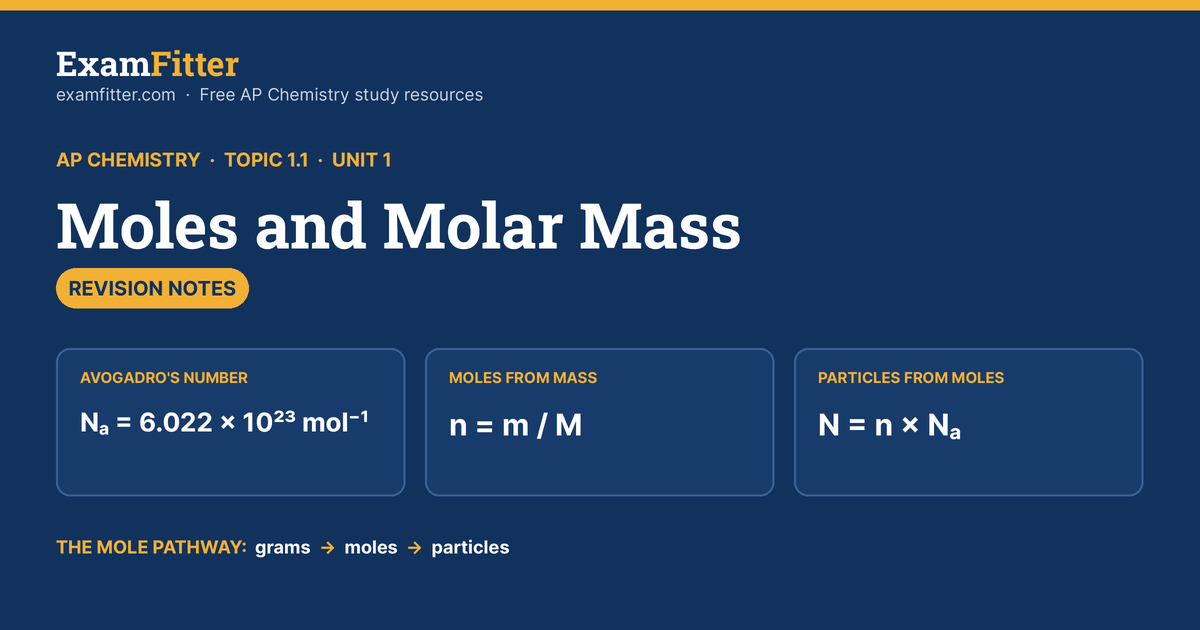
The Mole: Counting Particles You Cannot See Atoms and molecules are far too small to count one by one, yet chemistry constantly needs to know how many of them are reacting. The mole solves this by counting particles in bulk. One mole of any substance contains exactly 6.022 × 10²³ representative particles. This fixed number … Read more