Topic 4.5: Stoichiometry Revision Notes

Topic 4.5: Stoichiometry Revision Notes
Coefficients Are Mole Ratios, Not Mass Ratios Stoichiometry is the arithmetic of a balanced equation: it converts an amount of one substance in a reaction into the amount of any other. A balanced equation is a recipe written in moles. Its coefficients count particles, and so moles, never grams. In N₂ + 3H₂ → 2NH₃, … Read more
Topic 4.4: Physical and Chemical Changes Worksheet

Topic 4.4: Physical and Chemical Changes Worksheet

How to Use This Worksheet Work in order. Section A checks the ideas: the particle test that separates the two kinds of change, what breaks in each, dissolving, and the limits of evidence. Section B builds the skill: classifying real scenarios with particle-level justifications and working the energy numbers. Section C combines classification, conservation and … Read more

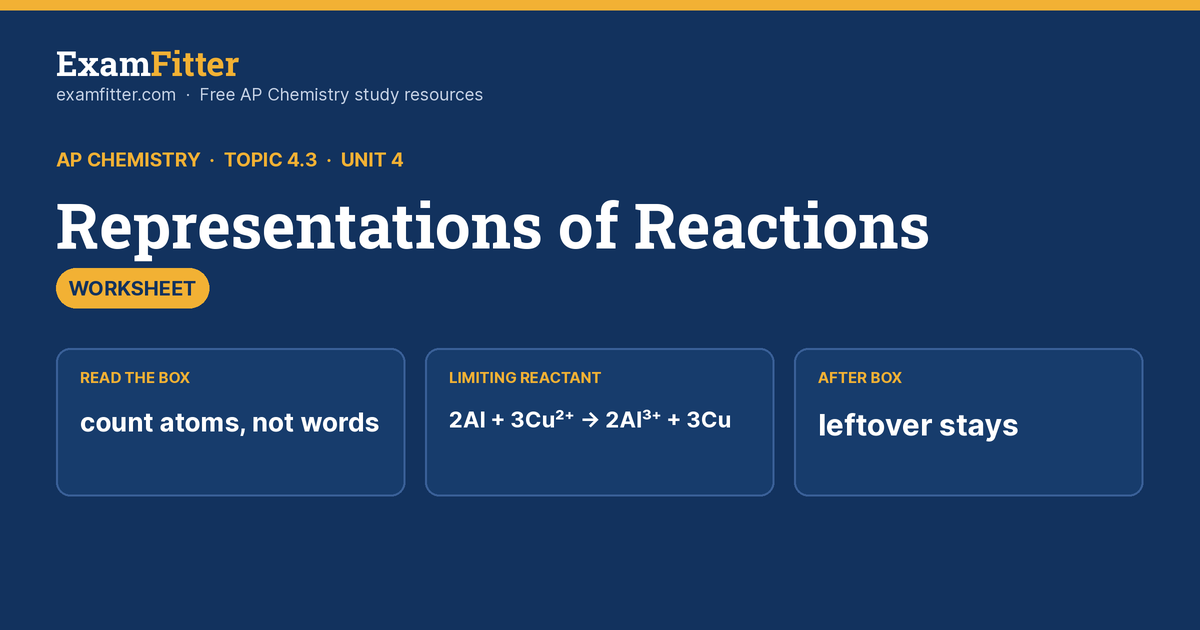
Topic 4.3: Representations of Reactions Worksheet

Topic 4.3: Representations of Reactions Worksheet

How to Use This Worksheet Work in order. Section A checks the ideas: the three levels of representation, what each one shows, and the conservation checks every diagram must pass. Section B builds the skill: describing before-and-after boxes in exact words and counts, translating between equations and diagrams, and reading leftovers. Section C combines translation, … Read more

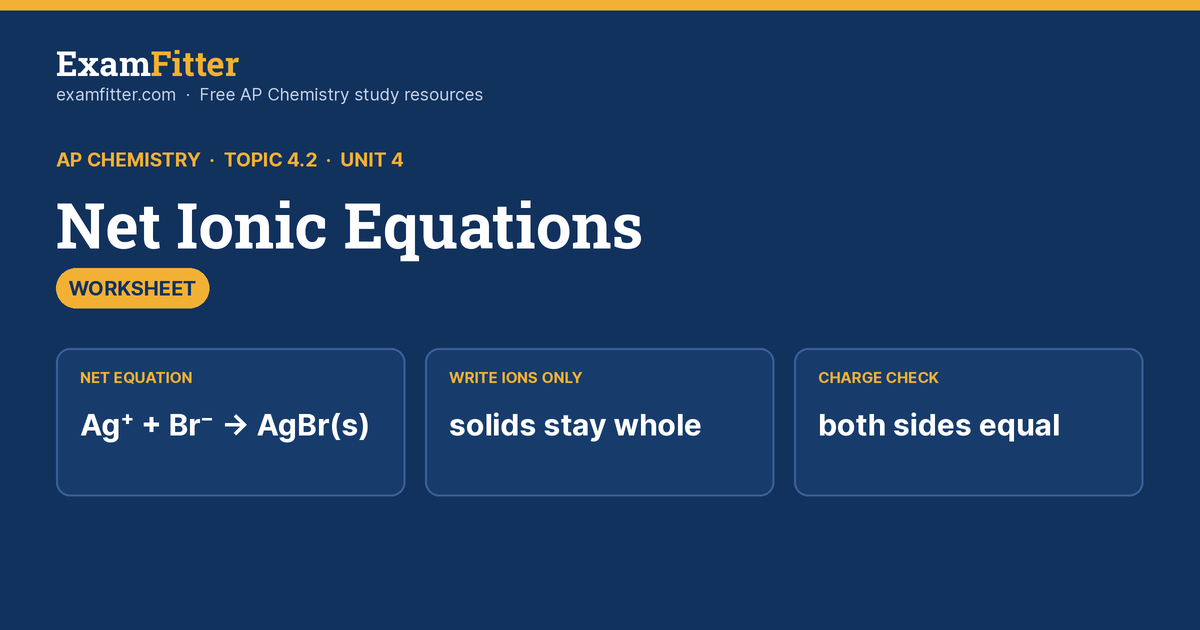
Topic 4.2: Net Ionic Equations Worksheet

Topic 4.2: Net Ionic Equations Worksheet

How to Use This Worksheet Work in order. Section A checks the ideas: the three levels of equation, spectator ions, and which species split into ions and which stay whole. Section B builds the skill: writing molecular, complete ionic and net ionic equations for precipitation, acid-base, weak acid and gas-forming reactions. Section C combines prediction, … Read more

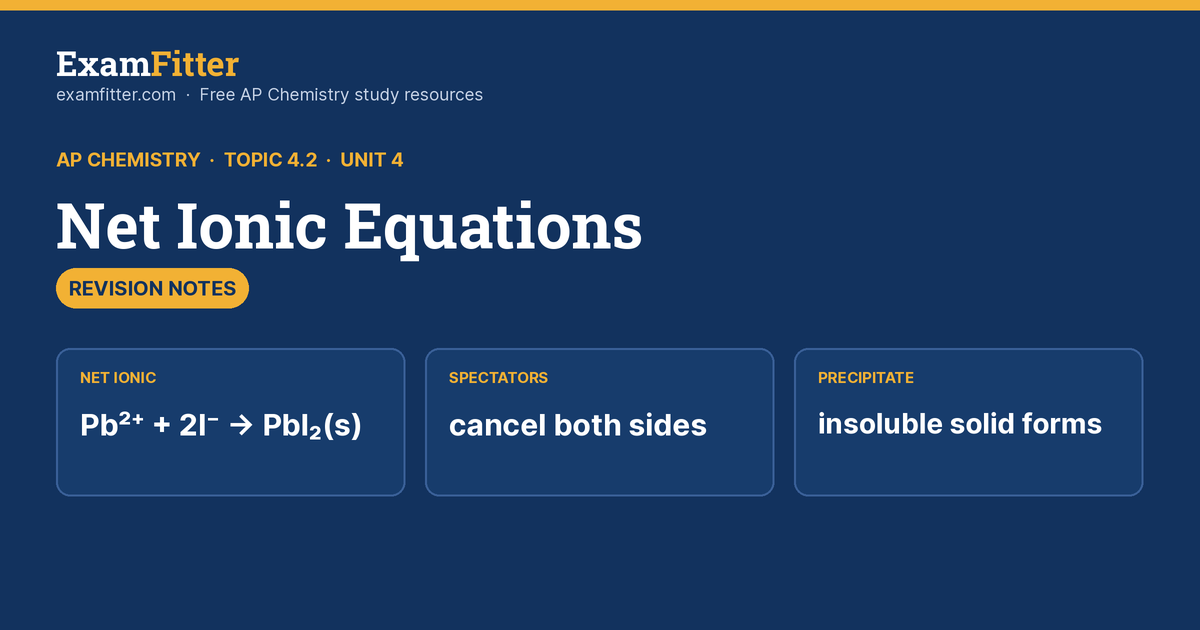
Topic 4.2: Net Ionic Equations Revision Notes

Topic 4.2: Net Ionic Equations Revision Notes

Three Levels of the Same Equation Most reactions in this unit happen in water, between species that are already dissolved. One reaction can be written at three levels of detail, differing in how much of what is present they show. The molecular equation writes every substance as a complete formula: AgNO₃(aq) + NaCl(aq) → AgCl(s) … Read more

Topic 4.1: Introduction to Reactions Worksheet

Topic 4.1: Introduction to Reactions Worksheet

How to Use This Worksheet Work in order. Section A checks the ideas: what a chemical reaction is, the signs that one has occurred, and how physical and chemical changes differ at the particle level. Section B builds the skills: balancing equations, reading coefficients, and using conservation of mass in calculations. Section C combines observations, … Read more

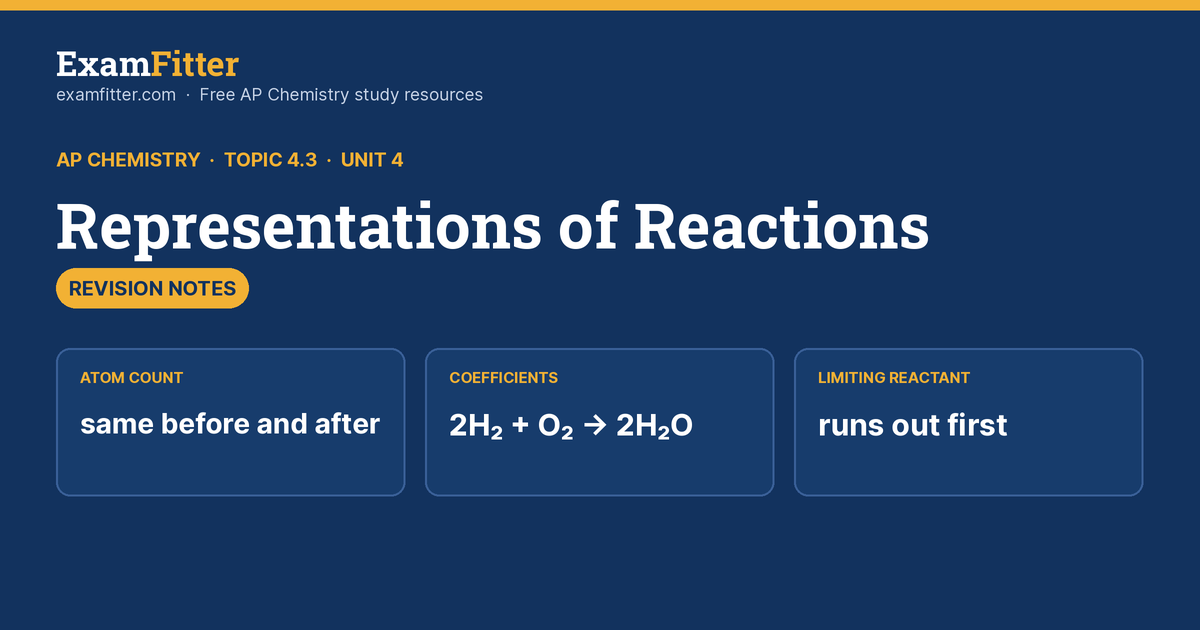
Topic 4.1: Introduction to Reactions Revision Notes

Topic 4.1: Introduction to Reactions Revision Notes

What a Chemical Reaction Is A chemical reaction is a rearrangement of atoms. The atoms in the reactants are regrouped, so new substances appear with different properties. The starting substances are the reactants, and the new substances formed are the products. Reactants are consumed and products are formed, but no atom is created and none … Read more

Topic 5.6: Reaction Energy Profile Quiz

Master AP Chemistry Topic 5.6 with this free practice quiz. Test your skills on energy profiles, transition state, and enthalpy of reaction to prepare for your AP exam. The Reaction Coordinate Diagram A reaction energy profile plots potential energy on the vertical axis, in kJ/mol, against reaction progress on the horizontal axis, the reaction coordinate. … Read more