Topic 5.5: Collision Model Worksheet

Topic 5.5: Collision Model Worksheet
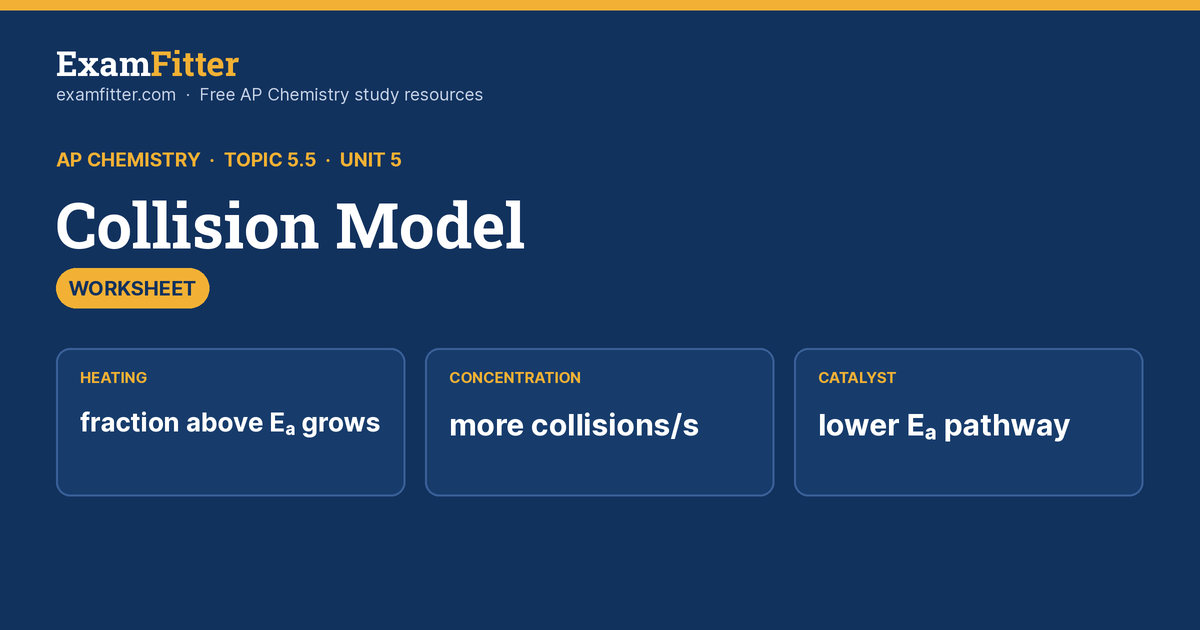
How to Use This Worksheet Work in order. Section A checks the definitions and the Maxwell-Boltzmann picture. Section B practises the counting: fractions above Eₐ, effective collisions per second, and what each change does and does not alter. Section C combines the ideas in exam style. Reference facts used throughout. An effective collision needs energy … Read more
Topic 5.7: Introduction to Reaction Mechanisms Quiz

Master AP Chemistry Topic 5.7 with this free practice quiz. Test your skills on multi step reactions, reaction intermediates, and overall reaction equations to prepare for your AP exam. A Mechanism Is a Sequence of Elementary Steps The overall equation of a reaction shows only the net change: which species are consumed and which are … Read more

Topic 5.5: Collision Model Revision Notes

Topic 5.5: Collision Model Revision Notes

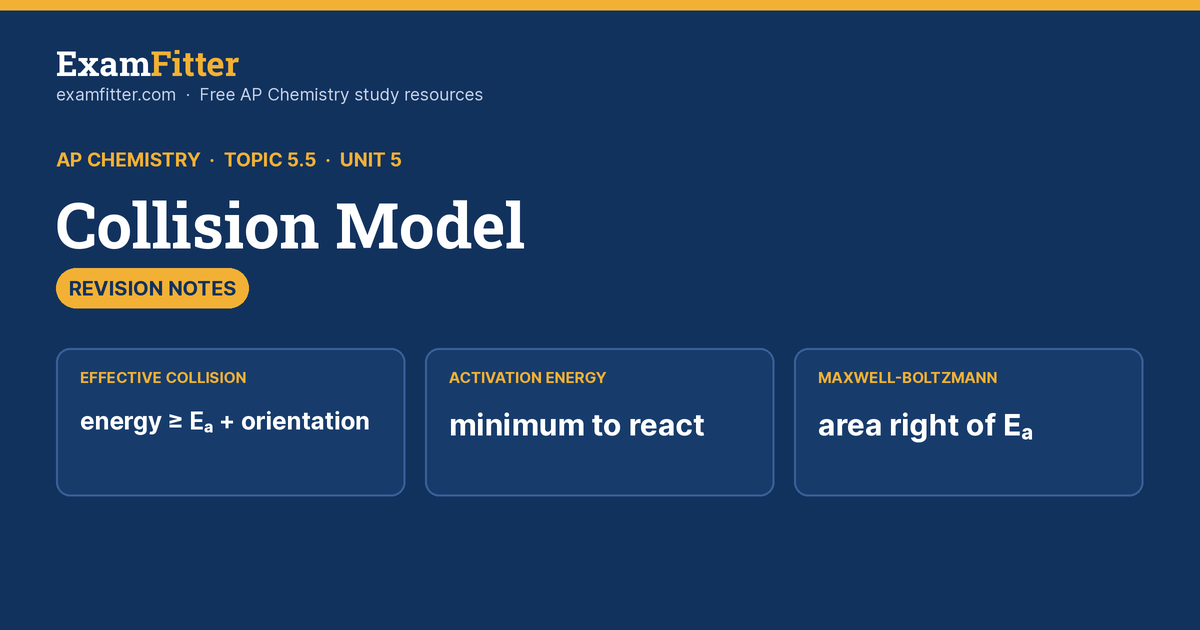
Reactions Happen in Collisions The collision model explains rates at the particle level. Reactant particles move constantly, and a reaction can only happen when the particles whose bonds must rearrange actually meet: a collision. The rate is set by how many collisions per second succeed, not by the total collisions. Three things decide that count: … Read more

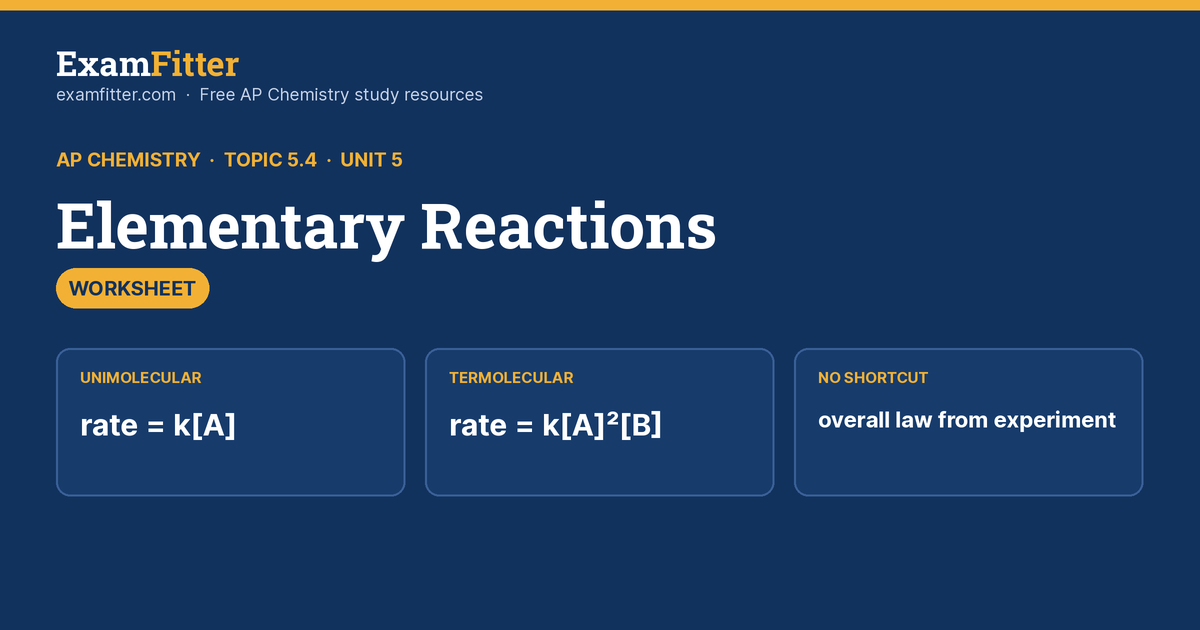
Topic 5.4: Elementary Reactions Worksheet

Topic 5.4: Elementary Reactions Worksheet

How to Use This Worksheet Work in order. Section A checks the definitions: what an elementary step is, how molecularity is counted, and why termolecular steps are rare. Section B practises writing rate laws for steps and calculating k and rates from them. Section C combines step analysis, mechanisms and rate law matching in exam … Read more

Topic 5.4: Elementary Reactions Revision Notes

Topic 5.4: Elementary Reactions Revision Notes

A Single Molecular Event An elementary reaction is a reaction that takes place in one single step, exactly as its equation is written. One molecular event occurs: reactant particles collide, or a single particle breaks apart, and bonds rearrange in that one event, with no hidden sub-steps. Its coefficients count the actual particles involved, not … Read more

Topic 5.1: Reaction Rates Worksheet

Topic 5.1: Reaction Rates Worksheet

How to Use This Worksheet Work in order. Section A checks the definitions, the sign rules and the units. Section B practises average rates from data tables, instantaneous rates from tangents, and converting between species with the coefficients. Section C combines all three in exam style. Reference facts used throughout. Reaction rate = change in … Read more