Topic 2.1: Types of Chemical Bonds Worksheet

Topic 2.1: Types of Chemical Bonds Worksheet
How to Use This Worksheet Work through the sections in order. Section A checks the ideas, Section B builds classification and comparison fluency, and Section C mixes everything the way an exam would. Keep the continuum in mind throughout: bonds are not three sealed boxes but a scale from nonpolar covalent to ionic, set by … Read more
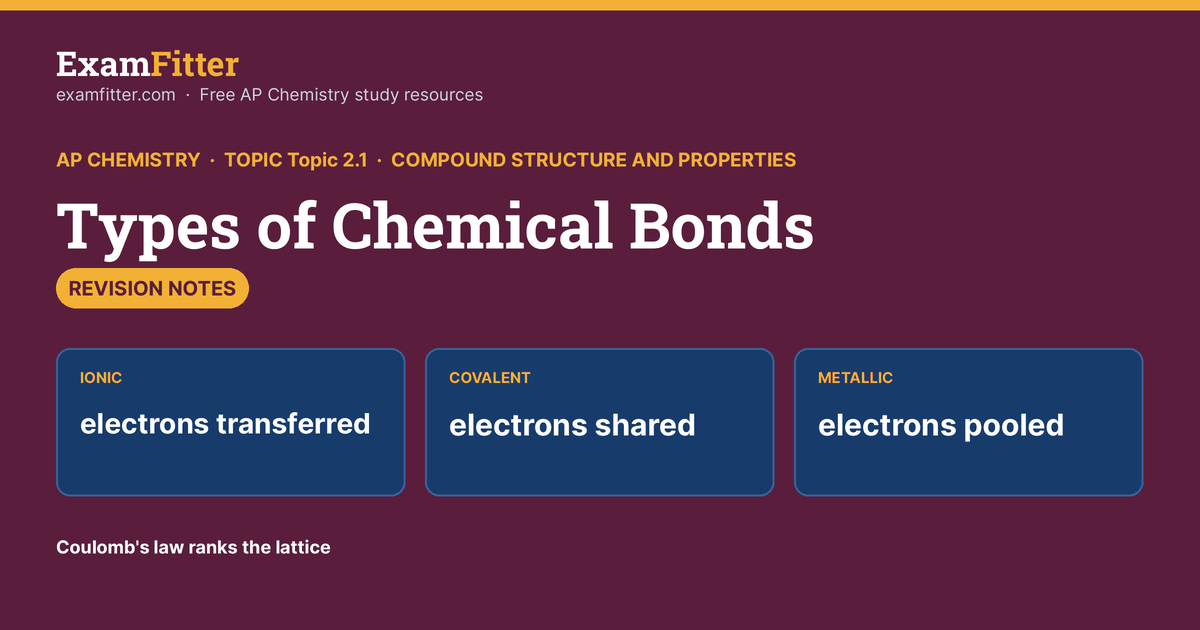
Topic 2.1: Types of Chemical Bonds Revision Notes

Topic 2.1: Types of Chemical Bonds Revision Notes

Why Bonds Form At All Atoms bond because the bonded arrangement has lower potential energy than the separated atoms. Electrons and nuclei arrange themselves into the configuration where attractions are maximized and repulsions are minimized, and that arrangement holds together. Every bond type in this topic is the same story told with different electron behaviour. … Read more

Topic 1.7: Periodic Trends Worksheet

Topic 1.7: Periodic Trends Worksheet

How to Use This Worksheet Work through the sections in order. Section A checks the ideas, Section B builds ranking fluency, and Section C mixes everything the way an exam would. One rule governs this whole topic: never explain a trend by restating it. Every justification must pass through Coulomb’s law: what happens to nuclear … Read more

Topic 4.2: Net Ionic Equations Quiz

Master AP Chemistry Topic 4.2 with this free practice quiz. Test your skills on spectator ions, complete ionic equations, precipitation reactions, and solubility rules to prepare for your AP exam. Three Levels of the Same Equation Most reactions in this unit happen in water, between species that are already dissolved. One reaction can be written … Read more

Topic 1.7: Periodic Trends Revision Notes

Topic 1.7: Periodic Trends Revision Notes

The One Idea Behind Every Trend Almost every periodic trend is Coulomb’s law wearing different clothes. The attraction between a nucleus and an electron grows with the charges involved and shrinks rapidly as the distance between them grows: F ∝ (q₁ × q₂) ÷ r². For a valence electron, the charge it actually feels is … Read more

Topic 1.6: Photoelectron Spectroscopy Worksheet

Topic 1.6: Photoelectron Spectroscopy Worksheet

How to Use This Worksheet Work through the sections in order. Section A checks the ideas, Section B builds fluency in reading spectra, and Section C mixes everything the way an exam would. Binding energies in this worksheet are simplified teaching values in MJ/mol, as on AP papers. Two habits will carry every question: peak … Read more

Topic 1.6: Photoelectron Spectroscopy Revision Notes

Topic 1.6: Photoelectron Spectroscopy Revision Notes

What a Photoelectron Spectrum Is Photoelectron spectroscopy, PES, is an experimental technique that reads an element’s electron configuration directly. A sample is hit with high energy photons, and the photons knock electrons out of the atom. Each photon gives up its energy to free one electron. Whatever energy is left over becomes the kinetic energy … Read more

Topic 1.5: Electron Configuration Worksheet

Topic 1.5: Electron Configuration Worksheet

How to Use This Worksheet Work through the sections in order. Section A checks the ideas, Section B builds fluency with configurations, and Section C mixes everything the way an exam would. For every configuration you write, check that the superscripts add up to the number of electrons before you move on. For unpaired electrons, … Read more