
Prepare for AP Chemistry Topic 1.3 with this practice quiz. Challenge yourself on percent composition, empirical formulas, and molecular formulas to boost your AP score.

Report a question

The Pre-Quiz Review
1. Elemental Composition of Pure Substances
A pure substance has a definite and consistent composition. For a pure compound, the elements are present in a fixed ratio by mass regardless of the size of the sample. This is the idea behind the law of definite proportions. Before the quiz, make sure you can distinguish an element from a compound and understand that changing the amount of a compound changes the total mass, not its composition.
Law of Definite Proportions
A given compound always contains the same elements in the same proportions by mass. For example, every pure sample of H₂O has hydrogen and oxygen in the same mass ratio, even if one sample is much larger than another.
If one sample contains twice as much compound as another, it contains twice the mass of each element. The percentage composition and mass ratio remain unchanged.
This principle is especially important when comparing two samples. If the ratios of the masses of the elements are the same, the samples can have the same composition even though their total masses are different.
Mass Percent from Elemental Data
If the masses of individual elements are given, first find the total mass of the sample:
Total mass = mass of all elements
Then calculate the mass percent of an element:
mass percent = (mass of element / total mass of compound) × 100
The percentages of all elements in a pure compound should add to approximately 100%, allowing for rounding.
2. Percent Composition
Percent composition describes how much of each element is present in a compound by mass. AP Chemistry questions may provide a chemical formula and ask for the percentage of a particular element, or provide percentages and require you to work backward toward an empirical formula.
Calculating Percent Composition from a Formula
To determine the percent by mass of an element, calculate the contribution of that element to one mole of the compound and divide by the compound’s molar mass.
For an element E:
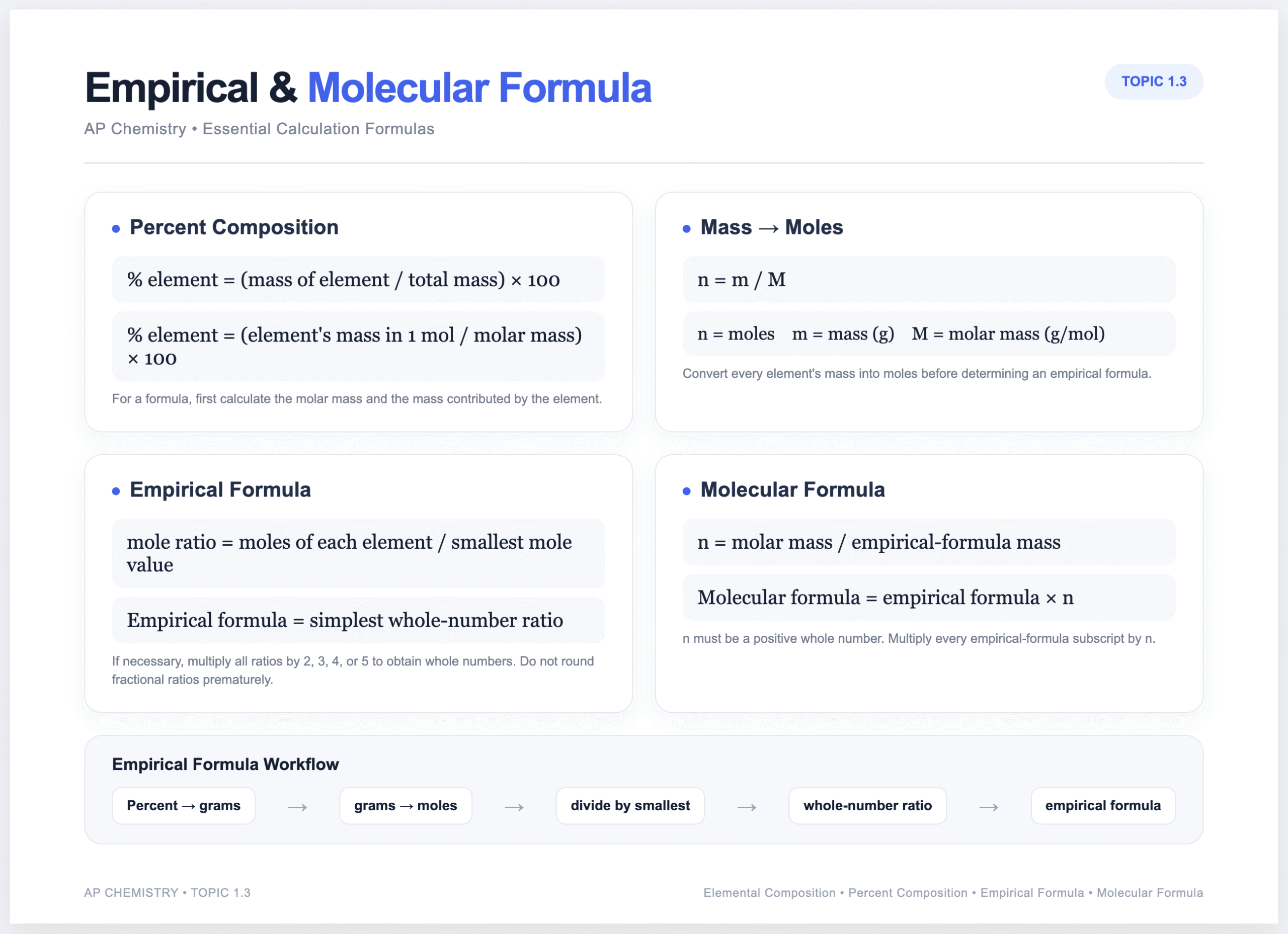
percent E = (mass of E in 1 mol compound / molar mass of compound) × 100
For example, in CO₂, the molar mass is approximately:
12.01 + 2(16.00) = 44.01 g/mol
The mass contributed by oxygen is 32.00 g per mole of CO₂. Therefore, oxygen accounts for approximately:
(32.00 / 44.01) × 100 ≈ 72.7%
Always remember to multiply the atomic mass by the element’s subscript before calculating its contribution.
Using Percentages as a Starting Point
When percentages are given for an unknown compound, assume a 100 g sample unless another sample mass is specified. This makes the numerical value of each percentage equal to the mass of that element.
For example, a compound containing 40.0% C, 6.7% H, and 53.3% O can be treated as:
40.0 g C
6.7 g H
53.3 g O
The next step is to convert each mass into moles.
3. Converting Mass to Moles
Empirical formulas describe ratios of atoms, so mass data must be converted into mole data before determining a formula. This is one of the most important steps in Topic 1.3.
Use:
moles = mass / molar mass
When percentages are given, the same process applies after assuming a 100 g sample.
For example, if a compound contains 24.0 g C:
moles C = 24.0 g / 12.01 g/mol ≈ 2.00 mol
Perform this conversion independently for every element present.
Do not compare the masses directly to determine an empirical formula. Different elements have different atomic masses, so equal masses do not represent equal numbers of atoms.
4. Determining an Empirical Formula
An empirical formula represents the simplest whole-number ratio of atoms in a compound. The key AP Chemistry skill is converting elemental composition into this ratio accurately. You should be able to move through the complete process without relying on memorized formulas beyond the basic mole relationship.
Standard Empirical Formula Procedure
When given the percentage composition of a compound, use the following sequence:
- Assume a 100 g sample if percentages are given.
- Convert each percentage into grams.
- Convert each mass into moles.
- Identify the smallest mole value.
- Divide every mole value by the smallest value.
- Convert the resulting ratios into whole numbers.
- Write the empirical formula using those whole-number ratios.
For example, suppose a compound gives approximately:
C = 40.0%
H = 6.7%
O = 53.3%
After conversion to moles:
C ≈ 3.33 mol
H ≈ 6.63 mol
O ≈ 3.33 mol
Divide by 3.33:
C : H : O ≈ 1 : 2 : 1
Therefore, the empirical formula is CH₂O.
Dealing with Ratios That Are Not Whole Numbers
The mole ratios will not always immediately appear as whole numbers because of experimental data and rounding. Recognize common fractions such as:
0.5 → multiply all ratios by 2
0.33 or 0.67 → often multiply all ratios by 3
0.25 or 0.75 → often multiply all ratios by 4
0.20 or 0.40 → often multiply all ratios by 5
For example:
1 : 1.5 → multiply everything by 2 → 2 : 3
Thus, an element ratio of 1 : 1.5 should not be rounded to 1 : 2. Multiplying by an appropriate integer preserves the chemically meaningful ratio.
Empirical Formula Is Not Always the Molecular Formula
A molecular formula may contain a whole-number multiple of the empirical formula. For example:
Empirical formula: CH₂O
Molecular formula: C₆H₁₂O₆
The molecular formula contains six empirical-formula units:
(CH₂O)₆ = C₆H₁₂O₆
Therefore, a formula such as C₂H₄O₂ may represent the same empirical ratio as CH₂O, but C₂H₄O₂ is not the empirical formula because its subscripts can still be reduced.
5. Molecular Formulas
The molecular formula gives the actual number of atoms of each element in one molecule of a molecular compound. Unlike an empirical formula, it does not necessarily represent the simplest ratio. The molecular formula is determined by combining the empirical formula with the compound’s molar mass.
Finding the Molecular Formula from Molar Mass
First calculate the empirical-formula mass. Then compare it with the experimentally determined molar mass.
Use:
n = molar mass / empirical-formula mass
The value of n should be a positive whole number.
Then multiply every subscript in the empirical formula by n.
For example, suppose:
Empirical formula = CH₂O
Molar mass = 180 g/mol
Empirical-formula mass:
12.01 + 2(1.01) + 16.00 ≈ 30.03 g/mol
Then:
180 / 30.03 ≈ 6
Multiply every subscript by 6:
(CH₂O)₆ = C₆H₁₂O₆
Therefore, the molecular formula is C₆H₁₂O₆.
Molecular Formula and Empirical Formula Relationship
The molecular formula must always be a whole-number multiple of the empirical formula.
Examples:
CH₂ → C₂H₄ → C₃H₆ → C₄H₈
NO₂ → N₂O₄ → N₃O₆
CH₂O → C₂H₄O₂ → C₃H₆O₃
If dividing all molecular-formula subscripts by their greatest common factor produces another whole-number formula, that simplified formula is the empirical formula.
6. Connecting Percent Composition, Empirical Formula, and Molecular Formula
These four ideas are closely connected and AP Chemistry questions often require you to move between them. Percent composition gives mass information, mass can be converted to moles, mole ratios give the empirical formula, and molar mass can then be used to determine the molecular formula.
The overall pathway to remember is:
percent composition → mass → moles → mole ratio → empirical formula → empirical-formula mass → molecular formula
A question may begin at any point in this pathway. You should be comfortable working forward or backward.
For example, if percentages are given, determine the empirical formula first. If molar mass is then provided, use it to determine the molecular formula.
If the molecular formula is already given, you can calculate its molar mass and percent composition directly.
7. Combustion Analysis and Formula Determination
AP Chemistry may provide combustion data for a compound containing carbon and hydrogen, or carbon, hydrogen, and oxygen. The masses of CO₂ and H₂O produced can be used to determine the amounts of carbon and hydrogen originally present in the sample.
For carbon:
moles C = moles CO₂
because each CO₂ molecule contains one carbon atom.
For hydrogen:
moles H atoms = 2 × moles H₂O
because each H₂O molecule contains two hydrogen atoms.
For a compound containing only C and H, the carbon and hydrogen obtained from the combustion products are sufficient to determine the empirical formula.
For a compound containing C, H, and O, determine the mass of oxygen by subtracting the calculated masses of C and H from the original sample mass:
mass O = original sample mass − mass C − mass H
Then convert oxygen’s mass to moles and determine the mole ratio.
8. Common AP Chemistry Mistakes to Avoid
The most common errors in empirical- and molecular-formula questions occur because students skip a conversion or simplify the ratio incorrectly. Before the quiz, specifically check that you can avoid the following mistakes.
Do not use percentage values directly as mole ratios. Convert percentages to grams and then to moles.
Do not divide by the largest mole value. Divide every mole value by the smallest value.
Do not automatically round values such as 1.5, 1.33, or 1.25 to 2, 1, or 1. These may indicate that the entire ratio needs to be multiplied by 2, 3, or 4.
Do not confuse empirical and molecular formulas. The empirical formula is the simplest ratio; the molecular formula gives the actual molecular composition.
Do not assume that the molecular formula can be determined from percentage composition alone. The molar mass or equivalent additional information is required.
When calculating percent composition, remember that the denominator is the total molar mass of the compound, not the atomic mass of the element.
9. Final Checklist Before the Quiz
Before starting the quiz, make sure you can explain what the law of definite proportions means and recognize that different-sized samples of the same pure compound have the same elemental composition by mass.
You should be able to calculate percent composition from a chemical formula and check that the percentages approximately total 100%.
You should be able to convert percentage composition into grams by assuming a 100 g sample, convert grams to moles, divide by the smallest mole amount, and obtain a whole-number ratio.
You should recognize when a ratio such as 1 : 1.5 requires multiplication rather than inappropriate rounding.
You should be able to distinguish an empirical formula from a molecular formula and simplify a molecular formula to its empirical formula.
Finally, you should be able to use the relationship
molecular formula = empirical formula × n
where
n = molar mass / empirical-formula mass
and recognize that n must be a whole number. These skills cover the core calculations and reasoning you should be ready to apply in the quiz.